













Smarter Healthcare Security: Solving Real-World Challenges
Protecting patients, staff and spaces with smarter security
Healthcare security is about more than locked doors
Healthcare facilities face a unique challenge: they must remain accessible to the people who need care while protecting patients, staff and sensitive areas from unauthorized access.
Unlike traditional commercial buildings, hospitals operate around the clock, with a constant flow of patients, visitors, contractors and healthcare professionals. Staff rotate between departments and facilities. Emergency responders need immediate access. Sensitive areas, including pharmacies, behavioral health units and patient records storage, require additional layers of protection.
For hospital security directors, balancing these demands can be increasingly complex, especially when security systems operate independently or rely on manual processes.
As healthcare facilities expand, renovate and adapt to changing operational needs, security strategies must evolve alongside them.
The question isn’t simply whether your facility has access control. It’s whether your security systems are helping your team operate more safely, efficiently and effectively.
Let’s explore some of the most common security challenges facing healthcare facilities and practical ways to address them.
1. Understanding the unique security risks across healthcare environments
Not every healthcare facility faces the same security challenges. Even within a single hospital, different departments have distinct operational requirements.
A successful security strategy begins by understanding how each space operates, who needs access and what risks must be addressed.
Hospitals and health systems
Large hospitals often manage thousands of employees, multiple departments and a continuous flow of visitors and contractors.
Security teams must coordinate access across shifts, buildings and sometimes entire campuses.
Key considerations:
- Managing employee and contractor access across departments and facilities
- Securing pharmacies, medication storage and other restricted areas
- Maintaining visibility into security events across multiple buildings
- Supporting efficient investigations and emergency response
Behavioral health facilities
Behavioral health environments introduce additional safety considerations. Security must help protect vulnerable patients while supporting clinical care, appropriate patient movement and life safety requirements.
Key considerations:
- Controlling access between patient units and restricted areas
- Supporting safe patient movement and preventing unauthorized departures
- Coordinating door controls with clinical workflows and emergency procedures
- Using appropriate ligature-resistant hardware in patient-accessible areas
- Maintaining safe emergency egress and regulatory compliance
Emergency departments and crisis stabilization centers
Emergency departments must balance rapid access with the need to protect staff and patients in unpredictable, high-pressure environments.
Key considerations:
- Managing access during high-volume or after-hours periods
- Controlling entry to treatment and staff-only areas
- Supporting emergency lockdown and response procedures
- Providing security teams with timely visibility into critical events
Multi-site healthcare organizations
Health systems, outpatient centers and specialty medical groups often operate across multiple locations, making consistent security management more challenging.
Key considerations:
- Managing credentials across facilities
- Standardizing security procedures and access permissions
- Quickly removing access when employees leave or change roles
- Maintaining centralized visibility without increasing administrative workload
While the challenges differ, the goal remains the same: protect people and critical spaces without creating unnecessary barriers to care.
2. Easing access management for a constantly changing workforce
Healthcare environments are dynamic. Nurses rotate between units, physicians work across facilities, temporary staff fill scheduling gaps and contractors require access for limited periods.
Managing these changes through traditional keys or disconnected access control systems can create administrative burdens and potential security gaps.
Consider a nurse who regularly works at multiple hospital locations. If each facility maintains a separate access control system, administrators may need to update permissions individually. When that employee changes roles or leaves the organization, verifying that access has been removed everywhere can become equally complicated.
A more centralized approach to access management can help healthcare organizations:
- Grant, modify and revoke permissions more efficiently
- Assign access based on job responsibilities and facility requirements
- Manage temporary credentials for contractors and visiting personnel
- Maintain records of credential activity
- Apply consistent access policies across multiple locations
The result is less time spent on routine administration and greater confidence that access permissions reflect current operational needs.
For security directors managing large or growing organizations, these efficiencies can have a meaningful impact on daily operations.
3. Reducing the risks of disconnected security systems
Many healthcare facilities have accumulated multiple security technologies over time.
Access control may operate on one platform, intrusion detection on another and building automation on a third. Video surveillance and other systems may introduce additional interfaces.
While each system serves a purpose, managing them separately can create challenges.
When a security incident occurs, operators may need to switch between platforms, review different event logs and manually reconstruct what happened.
That process takes time, particularly when every second matters.
The hidden cost of fragmentation
Disconnected security systems can contribute to:
- Duplicate administrative work
- Multiple interfaces for security personnel to monitor
- Delays when investigating incidents
- Inconsistent procedures between departments or facilities
- Additional training and maintenance requirements
- Difficulty coordinating responses across systems
For example, imagine an unauthorized access attempt at a restricted pharmacy entrance after hours.
With separate systems, security personnel may need to review access records, investigate an alarm and locate relevant information across multiple interfaces.
With a unified approach, related security events can be managed through a more centralized environment, helping operators understand the situation and coordinate an appropriate response.
Unified security isn’t simply about convenience. It’s about giving security teams the information and tools they need to make better decisions, faster.
4. Addressing specialized security challenges in behavioral health
Behavioral health facilities require a particularly thoughtful approach to security.
Unlike many other healthcare environments, security measures must account for patients who may be vulnerable to self-harm, elopement or other safety risks.
The goal is to maintain a therapeutic environment while implementing appropriate protections for patients, staff and visitors.
Controlled movement between units
Behavioral health units may require additional controls to manage movement between patient areas, treatment spaces and public corridors.
Door interlocking, where permitted and appropriately designed, can help manage movement through controlled entrances by coordinating when doors may be opened.
Specialized hardware considerations
Patient-accessible areas may require ligature-resistant hardware and protective enclosures designed to reduce opportunities for self-harm.
Security system design should account for these specialized requirements while supporting clinical operations.
Coordinated emergency response
Security teams may need to initiate predefined responses during emergencies, including restricting access to certain areas or coordinating alarms and notifications.
These responses must be designed around the facility’s approved emergency procedures and applicable life safety requirements.
Supporting staff safety
Access permissions, duress alarm integrations and coordinated security events can help staff request assistance and support faster security responses.
The most effective behavioral health security strategies bring together security directors, clinical leadership, facilities teams and life safety professionals to ensure technology supports patient care rather than complicating it.
See this in action. Our ICT Solution Series video, Protecting Behavioral Health Facilities, explores real-world challenges and demonstrates how unified security technology can help create safer environments.
Watch the behavioral health solutions video
5. Improving security visibility, accountability and compliance
Healthcare security teams are responsible for more than preventing unauthorized access. They also need to investigate incidents, support internal reviews and maintain reliable records of security activity.
When an incident occurs, understanding who accessed a particular area and when can be critical.
Access control systems can provide valuable records, including credential activity, door events and changes to access permissions.
These records may support:
- Security incident investigations
- Internal audits and compliance reviews
- Verification of access to restricted areas
- Reviews of staff and contractor access permissions
- Documentation of security procedures
For example, if an incident occurs in a restricted treatment area, reviewing credential activity may help security personnel establish a timeline and identify relevant access events.
However, access control records are only one component of a broader compliance strategy. Healthcare organizations must also consider applicable privacy requirements, organizational policies and the limitations of credential-based records.
The objective is to make reliable security information easier to access, review and act upon when needed.
6. Understanding the true cost of security inefficiencies
For healthcare security directors, justifying technology investments often requires demonstrating value beyond the initial purchase price.
A system may appear functional, but inefficient workflows can create hidden costs over time.
Consider how much time your organization spends:
- Manually updating access permissions
- Coordinating access across multiple facilities
- Responding to avoidable door alarms
- Replacing lost keys or rekeying restricted areas
- Investigating incidents across disconnected platforms
- Managing separate security vendors and maintenance agreements
Individually, these activities may seem minor. Across a large healthcare organization, they can add up.
Turning operational challenges into a business case
Consider a healthcare organization with 12 facilities that processes approximately 60 access changes each month.
If every change requires 15 minutes of administrative coordination, that represents approximately 15 staff hours per month, or 180 hours annually.
A centralized access management process could potentially reduce that workload while improving consistency and oversight.
When evaluating security improvements, consider measuring:
- Time required to grant or remove access
- Number of systems operators must use
- Time spent investigating incidents
- Frequency of unnecessary service calls
- Costs associated with physical keys and rekeying
- Administrative effort required to support additional facilities
Establishing a baseline helps security directors communicate the operational value of improvements to executive leadership.
The strongest security investment decisions consider not only what a system costs to purchase, but also what it costs to operate over time.
7. Planning security upgrades without disrupting patient care
Healthcare facilities rarely have the luxury of shutting down operations for a security upgrade.
Hospitals must continue caring for patients while renovations, system replacements and infrastructure improvements take place.
A successful modernization strategy requires careful planning and coordination.
Involve the right stakeholders early
Security directors should work closely with facilities, IT, nursing leadership, clinical operations and life safety personnel when evaluating changes.
Each group brings important requirements that can influence system design and implementation.
Evaluate existing infrastructure
Replacing an entire security system isn’t always necessary.
Before beginning an upgrade, assess which readers, credentials, door hardware and supporting technologies can be retained or integrated into a new system.
A phased approach may help protect existing investments while reducing disruption.
Prioritize life safety and clinical operations
Door locking arrangements, emergency egress, fire alarm interfaces and specialized patient care environments must be reviewed against applicable codes and facility requirements.
Work in occupied healthcare spaces may also require infection prevention measures, approved installation windows and temporary safety procedures.
Establish clear testing and training procedures
Before a new system goes live, confirm that critical functions operate as intended.
This may include testing access permissions, alarms, emergency procedures and after-hours response workflows.
Security personnel and other affected staff should understand how the system operates and who is responsible for responding to events.
Measure performance after implementation
Review results after the system has been operational for 30 to 90 days.
Are access changes faster? Are security events easier to investigate? Has the administrative workload decreased?
These results can help determine whether the approach should be expanded to additional departments or facilities.
8. How unified security technology can support healthcare operations
Addressing healthcare security challenges requires technology that can adapt to different environments, integrate with existing infrastructure and support daily operations.
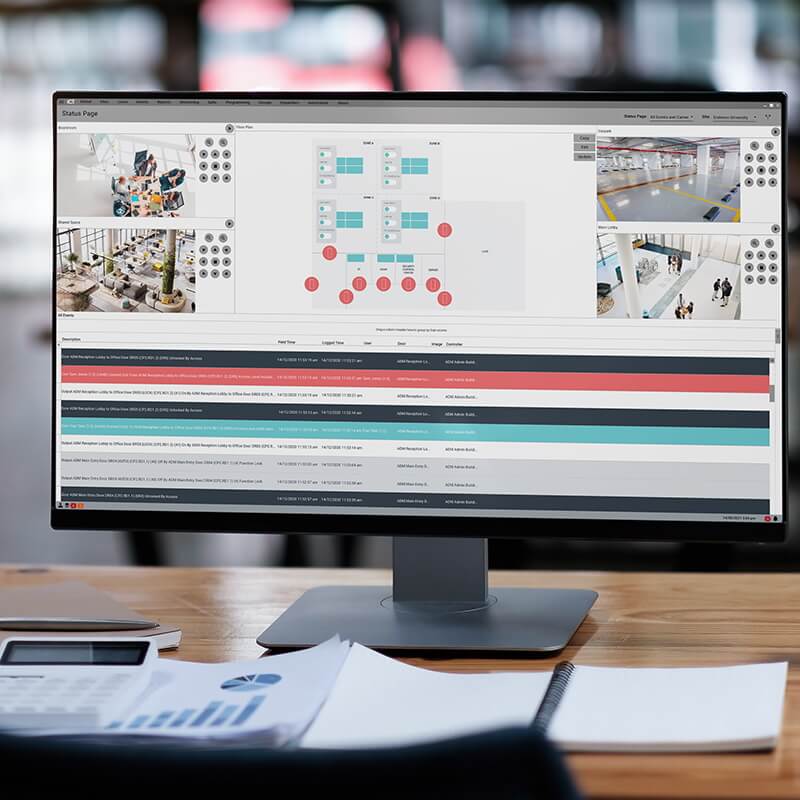
ICT’s Protege GX brings access control, intrusion detection and building automation together in one unified platform.
For healthcare organizations, this approach offers several potential advantages.
Centralized security management
Manage access permissions, monitor events and coordinate supported security functions through a unified platform, helping reduce the complexity of managing multiple systems.
Flexible access control
Support a range of access requirements, from everyday staff credentials to more restrictive controls for sensitive areas.
Capabilities such as dual custody, anti-passback and two-factor authentication can provide additional control where appropriate.
Support for specialized environments
Protege GX supports functions such as door interlocking and configurable security responses that can be incorporated into appropriately designed behavioral health and other specialized healthcare environments.
Integration with existing technology
With more than 50 integrations, including video management, elevator and biometric technologies, Protege GX can help healthcare organizations build around compatible existing investments.
Scalable security across facilities
As healthcare organizations expand, a consistent security platform can support standardized procedures and access management across additional locations.
Long-term value
Protege GX’s licensing approach, including no per-user licensing fees, can help organizations manage costs as staffing requirements and facility operations evolve.
Together, these capabilities help healthcare security teams focus less on managing disconnected technologies and more on protecting the people and spaces that matter.
9. Six questions every healthcare security director should ask
Whether you’re planning a major upgrade or evaluating your current security operations, these six questions can help identify opportunities for improvement.
1. How quickly can we grant, modify or remove access?
Consider what happens when employees change departments, contractors finish projects or staff leave the organization.
2. Can our team see critical security activity in one place?
Evaluate how easily operators can monitor events and investigate incidents across existing systems.
3. Are our highest-risk areas adequately protected?
Review access requirements for pharmacies, behavioral health units, emergency departments and other sensitive spaces.
4. Are our security systems creating unnecessary administrative work?
Identify processes that require duplicate data entry, manual coordination or multiple system interfaces.
5. Can our current infrastructure support future growth?
Consider whether your security strategy can accommodate renovations, acquisitions, new facilities and changing operational requirements.
6. Can we demonstrate the value of our security investments?
Look beyond equipment costs and consider operational efficiency, administrative time, security visibility and long-term scalability.
The answers can help establish priorities and guide conversations with internal stakeholders and security integration partners.
Building a safer, smarter healthcare environment
Healthcare security will always involve balancing accessibility, patient safety, operational efficiency and regulatory requirements.
But managing those competing priorities doesn’t have to mean managing disconnected systems or relying on increasingly complex manual processes.
By understanding facility-specific risks, improving access management and adopting a more unified approach to security, healthcare organizations can create environments that are safer, easier to manage and better prepared for the future.
The right security strategy does more than protect doors. It supports the people and operations behind them.
See smarter healthcare security in action
Every healthcare facility faces unique challenges. Discover how ICT’s unified healthcare security solutions can help address real-world security needs.
Watch the ICT Solution Series: Protecting Behavioral Health Facilities
Want to explore how unified security could support your organization? Connect with ICT to discuss your healthcare security challenges and find an experienced security integration partner.