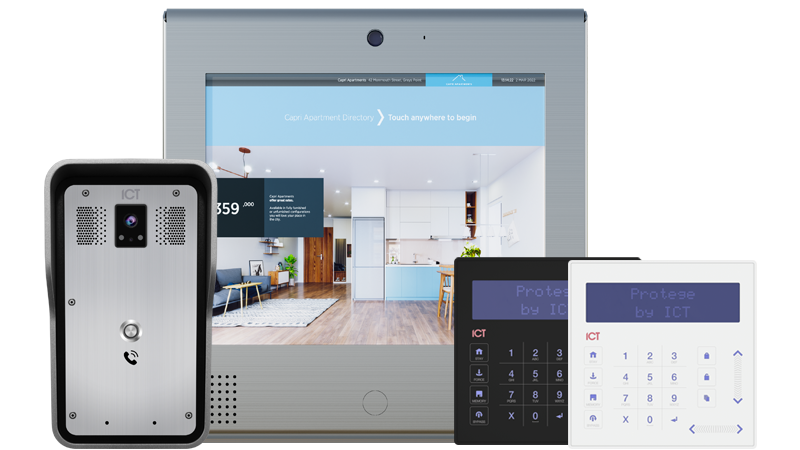













Protege Alphanumeric
LCD Keypad
PRT-KLCD
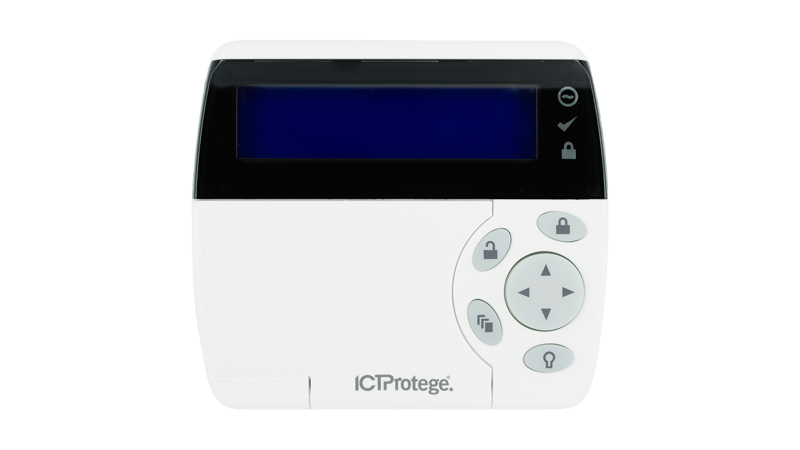
The Protege Alphanumeric LCD Keypad provides a user friendly human interface to the Protege integrated system, providing seamless and powerful integration of access control, security and building automation. In addition to sophisticated access features, the keypad incorporates system monitoring and control. Authorized users are able to perform arming and disarming, monitor inputs, control outputs and manage user access, all from the convenience of the keypad.
- Supports dual credential entry (User ID + PIN)
- Combine with a card reader for two-factor authentication (Card + PIN)
- Individual reportable duress code for each LCD Keypad
- Customizable display options
Features
Arming/Disarming
The keypad allows a user to arm and disarm an area or group of areas:
- Area progress is shown on the LCD display, which guides the user through the arming or disarming procedure with user friendly plain text messages
- Easily view open system inputs during the pre-arming phase
- Local display of user area for quick confirmation of arming and disarming
- Direct input bypass option
Auto Logout Confirmation
The keypad can be programmed for a custom auto logout time specific to each station.
System Object Control and Monitoring
Monitoring of all objects within the system can be achieved from the keypad:
- Monitor the status of any door, user (anti-passback), input, or output directly
- Offline functions allow quick key menu functions to be performed on objects used for automation (lights, HVAC, gates, doors)
- Single automation quick key for REX (Request to Exit) or output activation
Time & Attendance
The Time & Attendance feature enables entry, exit, and even break times to be displayed on the keypad, providing users with a clear and definitive view of their recorded start and finish times.
User Management
User management functionality provides a quick and convenient way to manage users at the keypad. Users can change their PIN code at any time, and enforced periodic expiry of PIN codes can be configured to improve system security. Authorized users are able to add new users with immediate access, modify incorrect user settings, and delete user records to immediately withdraw access.
Dual Credential Security
To provide an increased level of security, a site can be configured to require dual credential authentication for user access to keypads. A reader can be added to require both card and PIN validation, or the keypad can be configured to require both user ID and PIN. The site can also specify PIN complexity rules and enforce automatic periodic PIN expiry to ensure regular changing of PIN codes.
Connectivity and System Expansion
Extending the Protege system with local inputs and outputs allows convenient and cost effective expansion with additional benefits:
- 4 inputs which can be used to perform any system alarm and automation functions with a dedicated enclosure tamper switch
- 1 low current output for driving any signaling device
- Configuration and addressing of the keypad is achieved by an easy to follow configuration menu available during initialization
Communication
A single RS-485 communication interface port used for all network communication functions and interconnection to other modules.
Specifications
| Ordering Code | |
| PRT-KLCD | Protege Alphanumeric LCD Keypad |
| Power Supply | |
| Operating Voltage | 11VDC to 14VDC |
| Operating Current | 38mA (59mA Max) |
| User Interface | |
| User Interface Display | Energy smart backlit LCD 16 x 2 alphanumeric display with enhanced viewing angle |
| User Interface Keypad | Energy Smart Backlit 24 Key Multi-Function Silicone Membrane |
| User Interface Keypad | Armed, LED Ready and LED Beeper |
| Inputs | |
| Inputs | 2 standard or 4 using Input Duplex mode |
| Outputs | |
| Outputs | 1 open collector (50mA Max) output. Programmable for all output functions. |
| Dimensions | |
| Dimensions (H x W x D) | 126 x 139 x 24mm (4.96 x 5.47 x 0.9") |
| Net Weight | 265g (9.3oz) |
| Gross Weight | 305g (10.8oz) |
| Operating Conditions | |
| Operating Temperature | UL/ULC 0° to 49°C (32° to 120°F) : EU EN -10° to 55°C (14° to 131°F) |
| Storage Temperature | -10° to 85°C (14° to 185°F) |
| Humidity | 0%-93% non condensing, indoor use only (relative humidity) |
Downloads
User Documentation
Firmware
Supporting Material
Certifications & Warranties
Regulatory Notices
RCM (Australian Communications and Media Authority)
This equipment carries the RCM label and complies with EMC and radio communications regulations of the Australian Communications and Media Authority (ACMA) governing the Australian and New Zealand (AS/NZS) communities.
AS/NZS 2201.1 Class 5
Protege systems conform to AS/NZS 2201.1:2007 Class 5 intruder alarm systems standards for the construction, operation, performance and installation of intruder alarm equipment and systems installed in clients' premises.
CE - Compliance with European Union (EU)
Conforms where applicable to European Union (EU) Low Voltage Directive (LVD) 2014/35/EU, Electromagnetic Compatibility (EMC) Directive 2014/30/EU, Radio Equipment Directive (RED) 2014/53/EU and RoHS Recast (RoHS2) Directive: 2011/65/EU + Amendment Directive (EU) 2015/863.
This equipment complies with the rules, of the Official Journal of the European Union, for governing the Self Declaration of the CE Marking for the European Union as specified in the above directives.
UK Conformity Assessment (UKCA) Mark
This equipment carries the UKCA label and complies with all applicable standards.
UL/ULC (Underwriters Laboratories)
UL1610 for Central-Station Burglar-Alarm Units
UL294 for Access Control System Units
CAN/ULC S304 for Signal Receiving Centre and Premise Burglar Alarm Control Units
CAN/ULC S319 for Electronic Access Control Systems
CAN/ULC S559 for Fire Signal Receiving Centres and Systems
Industry Canada
ICES-003
This is a Class A digital device that meets all requirements of the Canadian Interference-Causing Equipment Regulations.
CAN ICES-3 (A)/NMB-3(A)
Federal Communications Commission (FCC)
FCC Rules and Regulations CFR 47, Part 15, Class A.
This equipment complies with the limits for a Class A digital device, pursuant to Part 15 of the FCC rules. Operation is subject to the following two conditions: (1) This device may not cause harmful interference; (2) This device must accept any interference received, including interference that may cause undesired operation.