












Using a Single Pane of Glass Approach in Banking Security Systems
The Problem with Siloed Security
Banks and financial institutions face a unique security challenge: they operate many interconnected systems across many locations, often managed by different teams using different software. Access control runs on one platform, video surveillance on another, intrusion detection on a third, and alarm monitoring somewhere else entirely.
This fragmentation creates gaps. When a security event occurs, operators waste critical minutes switching between systems, manually correlating timestamps, and piecing together what actually happened. In a sector where seconds matter — during a robbery, an unauthorized vault access, or a compliance audit — those delays are unacceptable.
What “Single Pane of Glass” Actually Means
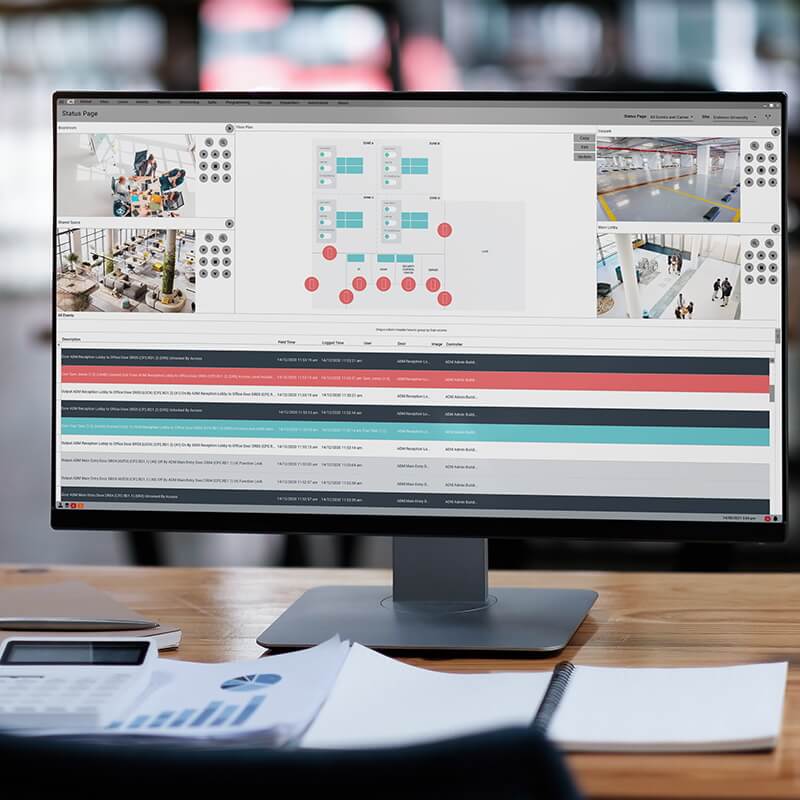
The single pane of glass concept is straightforward: all security subsystems feed into one unified interface. An operator sitting at a single workstation can monitor access events, view live and recorded video, manage alarms, and control intrusion detection — without switching applications or logging into separate platforms.
This is not about replacing every subsystem with a single product. It is about integrating best-in-class components so they communicate seamlessly and present a coherent picture to the people making real-time decisions.
Why Banking Security Demands Unification
Financial institutions have specific requirements that make unified security management particularly valuable:
- Branch networks — a regional bank may operate dozens or hundreds of branches, each with its own access control, cameras, and alarms. Managing these as separate systems per location is operationally unsustainable.
- Regulatory compliance — banking regulators expect clear audit trails that span all security systems. When access logs and video evidence live in separate silos, producing a complete compliance report becomes a manual, error-prone process.
- Vault and safe management — vault access requires multi-person authorization, time-delayed entry, and complete video verification. These workflows only function reliably when access control and video are tightly integrated.
- ATM security — monitoring ATM access, tamper detection, and associated video feeds from a central location requires a unified platform.
How Integration Works in Practice
Consider a typical scenario: a staff member badges into the vault room outside of scheduled hours. In a siloed environment, this might generate an access log entry that nobody reviews until the next audit. In a unified system, the event triggers an immediate alert on the operator’s dashboard, automatically pulls up the associated camera feed, and logs the entire sequence for compliance review.
The same principle applies across dozens of daily events — after-hours branch access, repeated failed credential attempts, doors held open at sensitive locations, or an intrusion alarm at a remote ATM vestibule. Each event is enriched with context from other subsystems and presented as a single, actionable notification.
Building a Unified Platform with Protege
ICT’s Protege platform is designed around this unified approach. Access control, intrusion detection, and building automation are managed natively within the same system, while certified integrations with video management platforms like Milestone XProtect and Avigilon bring video into the same operational view.
For banking environments, Protege supports multi-site management from a centralized head office, role-based operator permissions to ensure staff only see what they need to, and detailed audit logging that satisfies regulatory requirements. The platform scales from a single branch to an enterprise deployment spanning hundreds of locations.
Moving Beyond Silos
The banking sector cannot afford fragmented security. Every gap between systems is a potential vulnerability — both operationally and from a compliance perspective. A single pane of glass approach does not eliminate complexity, but it ensures that complexity is managed intelligently, with every subsystem contributing to a unified, real-time understanding of what is happening across the entire organization.